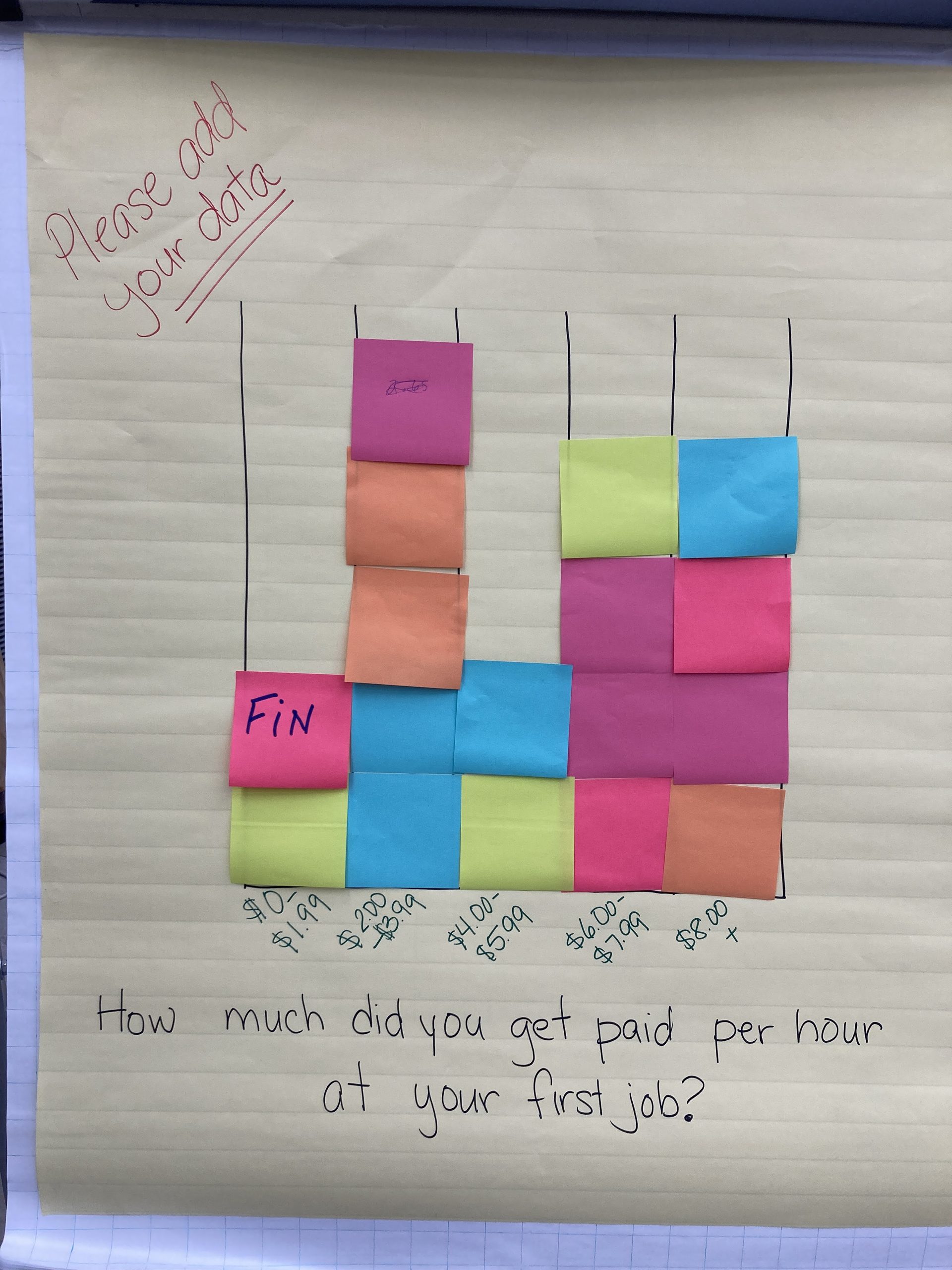
Using sticky notes and easel paper, you can make graphs with students that uses their data and introduces them to data visualization. Set up a blank graph on easel paper and ask students to contribute their information. You can also ask them to write their name so that it can be read across the room, which makes it a good activity for the beginning of a semester/cycle. But it also makes for a good instructional routine to use regularly in class.
Possible questions include:
- How much did you get paid at your first job?
- How many languages do you speak?
- How long does it take for you to get to school each day?
- How do you travel (car, bike, bus, train, walk)?
- How many people are in your family?
- How many hours do you spend on social media every day?
- How many hours do you spend speaking English each week?
- Etc.
We like to choose questions that will connect to our topic for the day. Think about how to quantity a personal question, invite students and then get students talking to each other before introducing the topic.
In-Person
Here are a few examples:
From a lesson on measles:
Which of these childhood diseases have you had?

After adding their information, students are asked:
- Does everyone know what each of these diseases are? (You might want to share Spanish or French translations of the names.)
- What do you know about each of these diseases? Do you know anyone who has had polio? How about rubella? Etc.
- What do you notice when you look at this graph?
- What questions do you have?
- What do you think this graph would have looked like 50 years ago?
- What do you think this graph would look like 50 years from now?
Online
Using Google Slides allows classes to create a quick classroom graph based on responses from students in the class. Students add their name and place it on the graph.

In this example, students are asked think about how much sleep they get on a typical night. Other questions could include:
- How many caffeinated drinks do you have have on a typical day?
- How many sodas do you drink on a typical day?
- How many children do you have?
- How long do you plan to study before taking the high school equivalency exam?
- How many languages do you speak?
- How far do you travel to get to work? To school?
You might also modify the activity to capture other kinds of information:
- Students could capture the pros and cons of an issue, Puerto Rico or DC statehood, for example?
- Change the categories to strongly agree, agree, disagree, strongly disagree and give students a statement to consider, possible related to a topic you will introduce in that class (description of this kind of activity):
- Humans have existed for about 3,000 years (from a prediction guide activity)
- Community college should be free
- COVID vaccination should be required for students in public school
- (Some other statement that will invite some difference of opinion to draw people into conversation)
For study materials related to data and statistics, see Being Counted: Probability & Statistics.
