Tag Archives: ESOL

Tips for Communicating with English Language Learners

Has this happened to you?

  • You invite a guest speaker to your ESOL class, but students find the native English speaker  incomprehensible. 
  • Your program hired non-instructional staff without experience interacting with English learners. Although well intentioned, they are having trouble communicating with students.
  • You teach high school equivalency and wish to better communicate with the English Language Learners in your class.

To address these common challenges, we created a handy one-page cheat sheet with simple, concrete ways native speakers can adapt their communication. The document is separated into four imperatives: 

  • scaffold new content
  • adjust what you say
  • adjust how you say it
  • incorporate comprehension checks

I now send this tip sheet to all guest speakers before they visit our class. I still ask them before they are in front of students if I may politely interrupt to quickly explain something important. As much as tip cheat can help, we are still the experts at anticipating what might be confusing for our students!

Explore the tip sheet during meetings with new support staff or HSE teachers who need to communicate with English learners.  For example, one tip is to try to avoid the use of phrasal verbs, since they are often confusing for English learners. What are phrasal verbs? It’s helpful to provide a list such as this so that staff understand how often we use them.

Let us know how you use the tip sheet! We welcome feedback!

ESL Literacy Readers: Australia, Canada and Oakland to the rescue!

Continue reading ESL Literacy Readers: Australia, Canada and Oakland to the rescue!

AI for Education

Curious about generative AI? Already using it? Educators associated with World Eduation’s various projects have created an abundance of great resources. They help to both understand the evolving technology (the potential and pitfalls) and showcase creative ways to apply it to our work. Highlighted below are a few but take some time to explore their website.

The “Ed Tech Bytes: Generative Artificial Intelligence” YouTube playlist includes four webinars, each approximately half an hour:

  • In Zero to Hero, get a better understanding of what generative AI is, what it can do, and why it matters.
  • In The Power of Open, we reflect on the importance of “open” and what it means when technology is included in the creative process. 
  • In Making it Work, hear tips and strategies from educational professionals that are using generative AI. 
  • In Humans in Focus, we explore what it means to include equity and ethics when we teach with and about AI.

The Open Prompt Book:

A Generative AI prompt is the information, sentences, or questions that you enter into a Generative AI tool. This prompt book dives into the explorations of adult educators who participated in World Ed’s “Camp GPT” project. Participants were introduced to Generative AI chatbots and two core strategies for using them: writing effective prompts and engaging in detailed dialogues (interacting with the chatbot to get what you’re looking for). The prompt book does a nice job of introducing strategies learned, and then highlighting sample text prompts. Participants asked ChatGPT to solve many issues we face, such as the creation of educational resources (ABE, ESOL, HSE, science, math, digital literacy, assessments, matching activities, mnemonic devices, rubrics… ) as well as supports for teacher training projects and administrative tasks. 

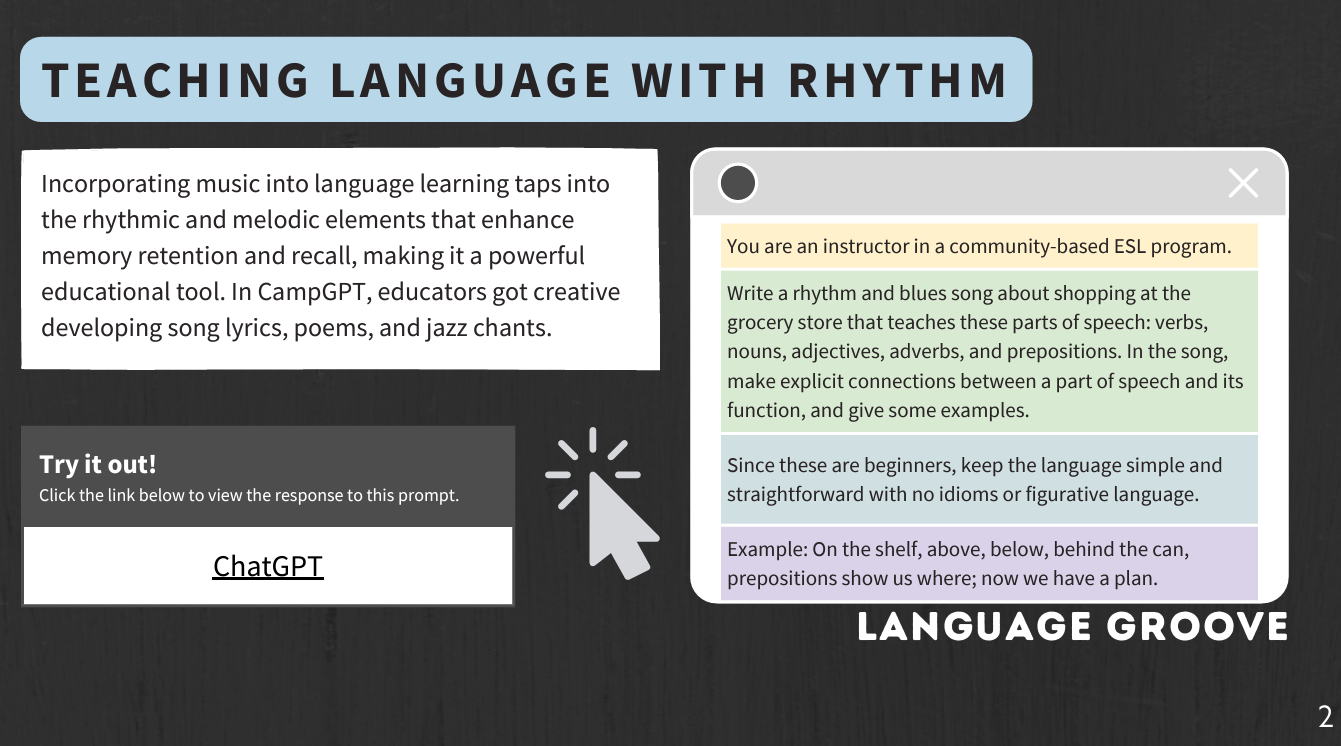
The wide variety of topics, specificity of the requests, documented results, teacher reflections, and helpful tips all contribute to a lovely document that is practical, educational, and inspiring. Here is one example to give you a sense of the structure and creativity:

Below is an excerpt of the result of the prompt found at the “Try it out!” for this prompt:

Continue reading AI for Education

Guide to Disability Accommodations for Adult Learners

Have you ever struggled to help your students understand the Americans with Disabilities Act form they are required to sign? Programs may have translated it into multiple languages and provided some examples, but it can still be confusing. It can be especially challenging for learners with limited formal education. Thanks to Literacy Minnesota and PANDA (Minnesota ABE Physical and Nonapparent Disability Assistance) we now have a clear, accessible guide.

Continue reading Guide to Disability Accommodations for Adult Learners